
FairPlay Bet — Real Exchange Slip With Back, Lay and a ₹300 Example
A FairPlay bet goes through an exchange slip that carries four things: the price you tapped, a stake box, a profit or liability line and the Place Bet control. Type ₹300, read the line, confirm. Below, that same ₹300 is worked through a back at 1.80 and the matching lay, followed by the market types on the slip, how an unmatched bet is edited or cancelled, when bets settle and what each of the three slip errors wants from you.

FairPlay Bet Sign In With a Quick ₹300 Stake Preview
No FairPlay bet can be placed from a signed-out screen. The sign in is three fields and takes about 40 seconds: user ID or mobile number, password, then the 4-digit check code printed beside the form. The third box on this ticket is only a preview of how the FairPlay stake box looks once ₹300 is typed into it.
A ₹300 slip needs an account behind it. Without one, a new FairPlay ID comes from the desk over WhatsApp in about 4 minutes, and the smallest deposit FairPlay takes, ₹300, happens to be the exact stake in the example further down.
FairPlay Bet on the Official FairPlay Exchange Slip
Real FairPlay Bet Terms Used on This Page
People who type fairplay bet into a search bar usually want one of two things: the slip itself, or proof that the fairplay betting site they landed on is the right one. Both lead to the same place. The fairplay exchange is the part of the account where prices come in two columns, back and lay, and where fairplay sports such as cricket, football and tennis each open their own market list. A FairPlay bet on any of them uses one slip and one wallet.
- Sign in with 3 fields, about 40 seconds.
- Open a match under fairplay sports and pick a market.
- Tap a back or lay price on the fairplay exchange.
- Type the stake, read profit or liability, place the fairplay bet.
Quick FairPlay Bet Reference for the Slip
Back holds the stake. Lay holds the liability. An unmatched FairPlay bet can be edited or cancelled, a matched one cannot, and nothing is paid out until the market result is confirmed. Every fairplay betting site address opens the same slip with the same balance, so the numbers in the ₹300 example below read identically wherever you sign in.
FairPlay Bet Worked Example: Real ₹300 Back and the Matching Lay
One stake, one price, both sides of the slip, every outcome added up.
Take a T20 match where the batting side, call it Team A, shows 1.80 in the back column and 1.82 in the lay column on FairPlay. Those two numbers are decimal odds. The digit before the point is your own stake coming back; everything after it is the profit per rupee. So 1.80 means 0.80 of profit for each rupee staked, and that is all the arithmetic a FairPlay bet ever needs.
Real FairPlay Bet Numbers: Backing Team A at 1.80
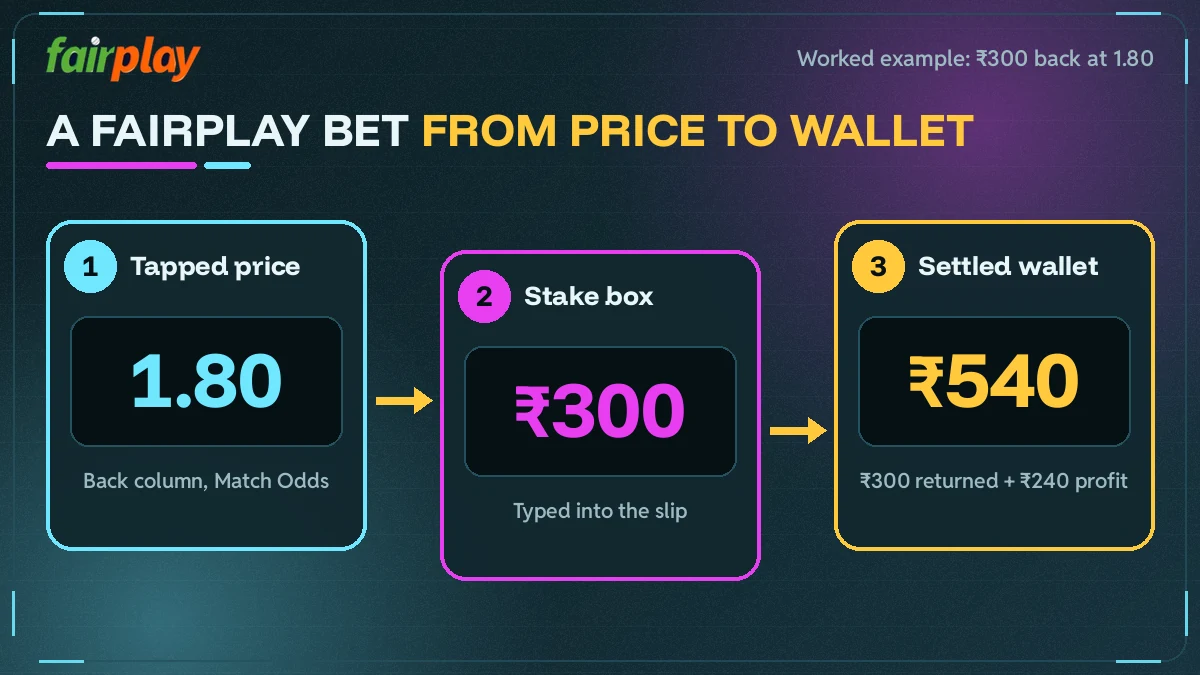
Tap 1.80 in the back column. The slip opens with the price filled in and an empty stake box. Type 300. Straight away the line under the box reads profit ₹240, because 300 multiplied by 0.80 is 240. Confirm it and FairPlay holds ₹300 from the wallet until the market settles.
- Side
- Back, Team A to win
- Price
- 1.80
- Stake typed
- ₹300
- Held from wallet
- ₹300
- Team A wins
- ₹300 returns plus ₹240 profit, ₹540 back in the wallet
- Team A loses
- The ₹300 stake is gone, nothing more
Short version: a back can never cost more than the number you typed.
The Matching Lay on FairPlay: Real Liability at 1.82
Now the other column. A lay at 1.82 says Team A will not win, and here the stake box means something different, which is where most first-time FairPlay users get caught. The ₹300 you type is the amount you stand to collect, not the amount you risk. What you risk is the liability: 300 multiplied by 0.82, which comes to ₹246. FairPlay holds that ₹246, not the ₹300, and the slip prints it on it's own line in place of the profit figure.
- Side
- Lay, Team A not to win
- Price
- 1.82
- Stake typed
- ₹300
- Held from wallet
- ₹246 liability
- Team A loses
- You keep the ₹246 and collect ₹300
- Team A wins
- The ₹246 liability is paid out
Notice the lay price is a touch higher than the back price. That two-point gap between 1.80 and 1.82 is the spread, and on a busy match odds market it stays narrow. On a thin market it widens.
Both FairPlay Bet Sides in One Quick Table
Put the two bets next to each other and the difference is plain. Same stake typed, different money at risk, opposite results.
| FairPlay slip | Risked | Team A wins | Team A loses |
|---|---|---|---|
| Back ₹300 at 1.80 | ₹300 | +₹240 | −₹300 |
| Lay ₹300 at 1.82 | ₹246 | −₹246 | +₹300 |
| Both together | ₹300 then ₹246 | −₹6 | ₹0 |
The last row is the one people skip. Backing and laying the same team for the same stake at the same moment does not cancel out to zero; it costs ₹6 if Team A wins, because 240 minus 246 is minus 6. That ₹6 is the spread, paid by you. Placing both sides at once is pointless, in other words, and the FairPlay slip will let you do it anyway.
Closing a Live FairPlay Bet After the Price Moves
The lay side earns its place later in the match. Say the ₹300 back at 1.80 is matched and Team A starts well, so the FairPlay price shortens to 1.50. A lay placed now can level the position across both results. The stake for that lay is the back return divided by the new price: 540 divided by 1.50 equals 360. Liability on it is 360 multiplied by 0.50, so ₹180.
| After the first ₹300 back at 1.80 | Lay stake | Liability | Team A wins | Team A loses |
|---|---|---|---|---|
| Price shortens to 1.50 | ₹360 | ₹180 | 240 − 180 = +₹60 | 360 − 300 = +₹60 |
| Price drifts to 2.40 | ₹225 | ₹315 | 240 − 315 = −₹75 | 225 − 300 = −₹75 |
The second row is the same sum run the other way. Team A loses two early wickets, the price goes out to 2.40, and the levelling lay is 540 divided by 2.40, which is ₹225 with a liability of 225 multiplied by 1.40, or ₹315. Both outcomes now show minus ₹75. Less then the full ₹300, but still a loss, and the slip does not soften that.
Read this before copying the numbers. The table is arithmetic on a FairPlay slip, not a forecast. Prices move against a bet about as often as they move for it, and the 1.80, 1.50 and 2.40 above were picked because they divide cleanly. Any commission line on your FairPlay statement sits on top of these figures. Whether exchange betting is allowed in your state is a separate matter, covered on the where a FairPlay bet stands under Indian law page.
Live FairPlay Bet Markets: Match Odds, Bookmaker, Fancy and Session
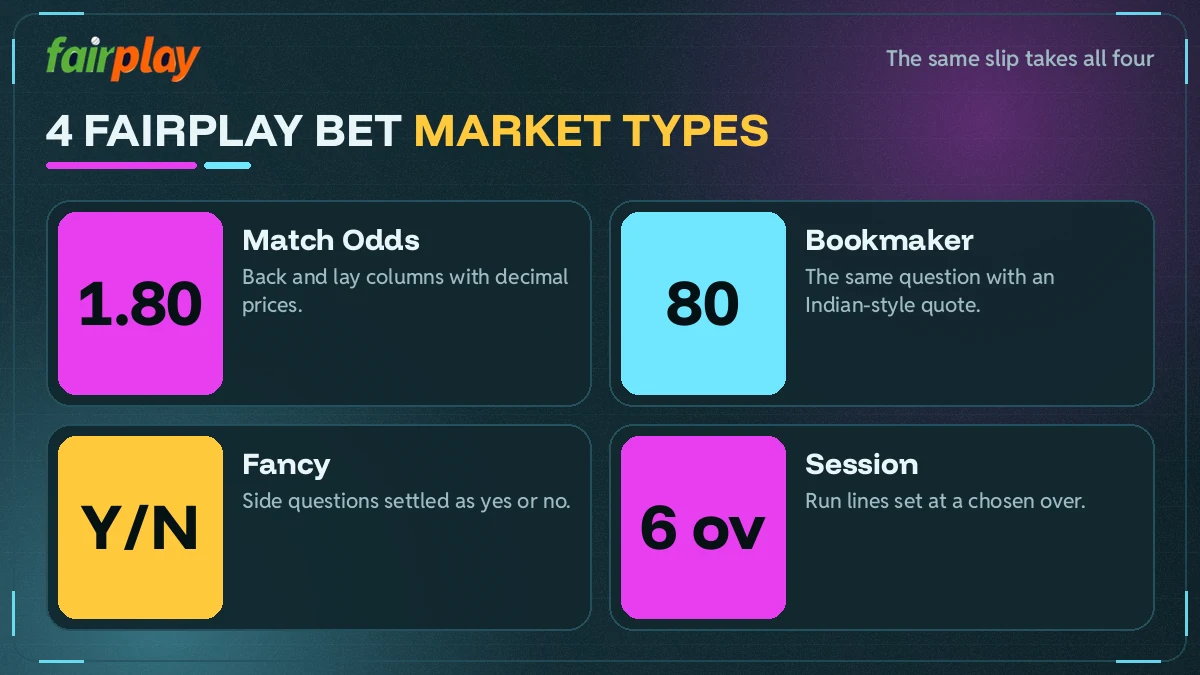
Four market types share the FairPlay slip, and they do not all behave like the ₹300 example. The stake box is the same. What changes is how the price is written and whether a lay column exists at all. A T20 fixture alone carries 70+ markets, listed in full on the FairPlay cricket page, but nearly every one of them falls into these four groups.
Match Odds
The exchange market proper. Decimal prices, a back column and a lay column, and your FairPlay bet is matched against another user taking the opposite side. This is the market the worked example uses. If nobody wants the other side at your price, the bet waits as unmatched.
Bookmaker
Same question, who wins, but the price is quoted the Indian way: 80 and 82 instead of 1.80 and 1.82. A ₹300 back at 80 shows the same ₹240 profit. Bookmaker bets on FairPlay are accepted at once or refused at once. There is no unmatched queue here.
Fancy
Side questions inside the match: runs by a named batter, a wicket method, a boundary count. Each line has a No number and a Yes number, say 24 and 26, with a rate beside it. On the FairPlay slip, Yes at 26 pays if the figure reaches 26 or more.
Session
Run lines cut at a set over. With the rate at 100, a ₹300 Yes at 49 on the first six overs collects ₹300 when the board reads 49 or higher as over six ends, and gives up ₹300 at 48 or lower. FairPlay closes that line there and then, long before match odds are done.
Football and tennis on FairPlay lean on match odds with a few extra lines such as over and under goals; fancy and session are cricket territory. Six sports sit on the live rail at any time (the FairPlay live page lists them), and the slip that opens from each is the same one.
Placing a FairPlay Bet Fast: Six Taps on the Slip
Once signed in, the route from the match list to a placed FairPlay bet is short. Roughly twenty seconds if the balance is already there.
- Start from the fixture. Each of the 6 sports on the FairPlay live rail has its own fixture list, and a tapped fixture lays its markets out in a set order: match odds first, bookmaker under it, the fancy block last.
- Settle the column before the number. In the example that means 1.80 on the left of the gap or 1.82 on the right. The slip header repeats the word Back or Lay, so the ₹300 lands on the side you meant.
- Type the stake. Enter 300 in the stake box, or tap one of the preset amounts under it. The Min and Max for that market are printed on the market header.
- Read the line. Profit for a back, liability for a lay. If the figure is not what you expected, you are probably on the wrong column.
- Press Place Bet. FairPlay checks the balance and the current price, then answers with placed or with one of the three errors covered below.
- Check the list under the slip. Matched bets and unmatched bets sit in two separate lists. Your ₹300 should be in one of them.
Step four is the one that matters. A common desk ticket reads like this: someone meant to back a team for ₹300, tapped the lay column by mistake at 3.50, saw a bigger number on the line and took it for profit. It was a ₹750 liability. The FairPlay slip had printed the word liability the whole time.
One more habit is worth keeping. Before confirming, glance at the price box again, because in a live market the number you tapped and the number now in the box can differ by a tick or two. FairPlay will not place the bet at a worse price without telling you, but it will stop and ask, and that pause in the last over of a chase feels longer than it is.
Fix a FairPlay Bet Quick: Edit, Cancel, Settlement and Slip Errors
Placing is half of it. The other half is what happens to a FairPlay bet between the confirm tap and the money landing, and what to do when the slip refuses.
Editing or Cancelling an Unmatched FairPlay Bet, Free of Charge
Ask for 1.85 on Team A while the back column reads 1.80 and FairPlay holds the ₹300 without placing anything. The request will sit in in the unmatched list until another user offers 1.85. It may never happen. While it waits, the line is yours to change, and tapping it brings up a price box, a stake box and a cancel control.
Change the price to the one on offer and the bet matches. Lower the stake from ₹300 to ₹200 and the spare ₹100 goes back to the balance at once. Cancel it and the full held amount returns. None of this costs anything.
Partly matched bets are the odd case. If ₹180 of your ₹300 was taken and ₹120 was not, FairPlay splits the bet across both lists; only the ₹120 can be edited or cancelled. The ₹180 is locked.
And a matched bet? It stays. There is no cancel control on the matched list, and the desk cannot remove one for you. The only exit is the opposite bet, exactly as in the 1.50 and 2.40 rows of the example. Bookmaker, fancy and session bets are accepted instantly, so they never pass through the unmatched list at all, which means they cannot be edited either.
An unmatched FairPlay bet left alone is cancelled automatically when the market goes in-play or closes, depending on the market, and the held balace is released.
When a FairPlay Bet Settles: Real Timing by Market
Settlement on FairPlay follows the market, not the broadcast. The winning runs on television are not the trigger; the confirmed result is.
| FairPlay market | Settles when | What can delay it |
|---|---|---|
| Match Odds | The official result is confirmed | Rain rules, a super over, a tie |
| Bookmaker | Same point as match odds | An abandoned match, which voids the bet |
| Session | That over or innings is complete | An innings cut short before the over is reached |
| Fancy | The event on the line is decided | A batter retiring, a shortened game |
Once a market settles, the FairPlay bet leaves the open bets list, the profit or loss posts to the wallet and a line appears in the statement with the market name and the amount. A void bet returns the held stake or liability in full. If a FairPlay bet still shows as open well after the result, send the bet ID to support, which answers 24x7 and usually within a couple of minutes.
Settled money is ordinary balance. It can go on another FairPlay bet or out to the bank; a UPI payout takes about 35 minutes, and the minimum and the bank route are laid out on the FairPlay withdrawal time page.
Three FairPlay Bet Slip Errors and the Fast Fix for Each
The slip has three ways of saying no. Each one names its own cause, and in none of them has FairPlay taken any money.
Insufficient balance
The wallet is smaller than the amount the bet must hold. On a back that is the stake. On a lay it is the liability, which can be larger than the stake: a ₹300 lay at 2.50 needs ₹450, so a ₹300 wallet fails. Lower the stake, pick a shorter price or add funds. Open bets count too, since money already held for another FairPlay bet is not spendable.
Odds changed
The price moved between your tap and your confirm. FairPlay shows the new price in the box and waits. Accept it if the profit line still suits you, or type your original price and let the bet queue as unmatched on match odds. On bookmaker and fancy there is no queue, so the choice is the new price or nothing.
Market suspended
Prices are frozen. This happens around a wicket, a boundary review, a rain break or the last ball of an over on session lines, and the columns lock with the word suspended across them. Nothing to fix. Wait for the FairPlay market to reopen, then tap the fresh price, because the old slip will not carry over.
A fourth message turns up now and then, stake outside limits, and it is the simplest of the lot: the amount typed is under the Min or over the Max printed on that market header. Retype it inside the range. If a FairPlay bet keeps failing with no message at all, sign out, sign back in and try once more before contacting the desk, since an expired session produces a blank refusal rather than a named error.
FairPlay Bet Searches on the Trusted Exchange
- fairplay bet
- fairplay betting site
- fairplay exchange
- fairplay sports
- fairplay bet slip
- fairplay exchange back and lay
- fairplay sports betting
- fairplay bet online
Official FairPlay Bet Pages to Open Next
- FairPlay Cricket markets
- FairPlay Live in-play rail
- FairPlay Withdrawal Time
- Fresh FairPlay ID for a first slip
- Is a FairPlay Bet Legal in India
FairPlay Bet Slip Doubts Cleared With Real Figures
How do I place a FairPlay bet on the exchange slip?
Pick a price from the back or lay column, enter the stake and check the line under it: ₹300 at 1.80 should read profit ₹240. Then press Place Bet and look for the bet under matched or unmatched. Sign in comes first, 3 fields and about 40 seconds, with ₹300 as the smallest deposit.
What is the difference between back and lay on FairPlay?
Back means the selection wins for you and lay means it loses for you. A ₹300 back at 1.80 risks ₹300 to make ₹240. A ₹300 lay at 1.82 risks ₹246 to make ₹300. Back holds your stake from the wallet, while lay holds the liability figure printed on the slip.
What is the minimum stake for a FairPlay bet?
The minimum stake is set per market and printed on the market header as a Min and Max pair. It is not one fixed figure across the FairPlay exchange, so check the header before typing. The ₹300 used in the example on this page equals the minimum deposit, so one deposit funds it.
When does a FairPlay bet settle?
Settlement waits for the confirmed result of that one market, so the ₹240 from a ₹300 back at 1.80 reaches the wallet only once the match is declared official. Session and fancy lines close sooner, at the end of their over. Until then the bet stays under open bets on the account rail.
Can I cancel a FairPlay bet after placing it?
Yes, as long as it is still unmatched. A ₹300 request at 1.85 that nobody has taken shows a cancel control plus two boxes for price and stake, and the held ₹300 is released the moment you cancel. After matching there is no cancel at all, only a second bet in the other direction.
Why was my FairPlay bet rejected?
Three slip errors cause most rejections: insufficient balance, odds changed and market suspended. Add funds or lower the stake for the first, accept the new price or retype it for the second, and wait for the market to reopen for the third. Nothing is deducted from the wallet when a bet is rejected.